Showing posts with label oothapam. Show all posts

Saturday, July 27, 2013

Savory Quinoa Pancakes / Quinoa Oothapam

One of my all-time favorite places to eat in the U.S is the Inn Season Cafe in the suburb of Royal Oak in Detroit. It is one of the very few restaurants I have been to that is completely vegetarian and vegan, and oh so gourmet! The dishes are inspired from several cuisines around the world, particularly Indian! How it warms my heart to see terms like "paneer" and "chutney" and "mini dosas" on the menu. All the dishes are inspired with their own unique touch, so every visit to the place is tremendously inspiring and satisfying. How they manage to whip up such fabulous vegan desserts is baffling!

One of the dishes that I love on the menu is - Quinoa Corn Cakes. It's not a regular on the menu, but on days that this dish features on the special menu, they are the first ones to sell out. I know firsthand. They are basically quinoa and corn oothappams with the most delish coriander chutney that tastes nothing like the Indian version of the chutney, but still incorporates some of the spices and ingredients.

Every time I eat at this place, my friend finds it hilarious that I chew on every morsel, intently trying to analyze what exact ingredients could have gone into the dish. I then make notes (how nerdy) and try to recreate it at home. So, this time, as I carefully chomped on the quinoa corn cakes, I caught a hint of wheat flour and some (what I suspect to be) quinoa flour. The cakes were delicately spiced with just salt, because it's a sin to overshadow their flavorful chutney. With such simple ingredients, you would wonder how these cakes are such best sellers. But, they are! Proof that simple, wholesome ingredients of good quality used in the right proportion can create a gourmet dish.

So this is my recreation and twist on the quinoa oothappams, without corn. The original version also has cooked quinoa in it, but I skipped adding cooked quinoa and instead went heavy with the quinoa flour.


Ingredients (12-13 small pancakes):
  1. 1 cup quinoa flour (dry roast the quinoa until it turns aromatic and slightly brown. Cool and grind to a powder)
  2. 1/2 cup whole wheat flour
  3. 2 cups buttermilk or diluted yogurt
  4. 1 teaspoon baking powder
  5. 1 teaspoon salt
  6. 2 green chillies, finely chopped
  7. 1 teaspoon chopped ginger
  8. 1/2 a medium onion, chopped
  9. some coriander leaves - about 1/4 cup
  10. A few teaspoons of olive oil or vegetable oil
Preparation:
  1. Mix together all the dry ingredients - quinoa flour, wheat flour, baking powder and salt. 
  2. Whisk the dry ingredients with buttermilk/yogurt until the batter is smooth and of the consistency of pancakes/oothappam/dosa
  3. Mix the chopped onions, ginger, green chillies and coriander leaves to the batter. No need to rest the batter.
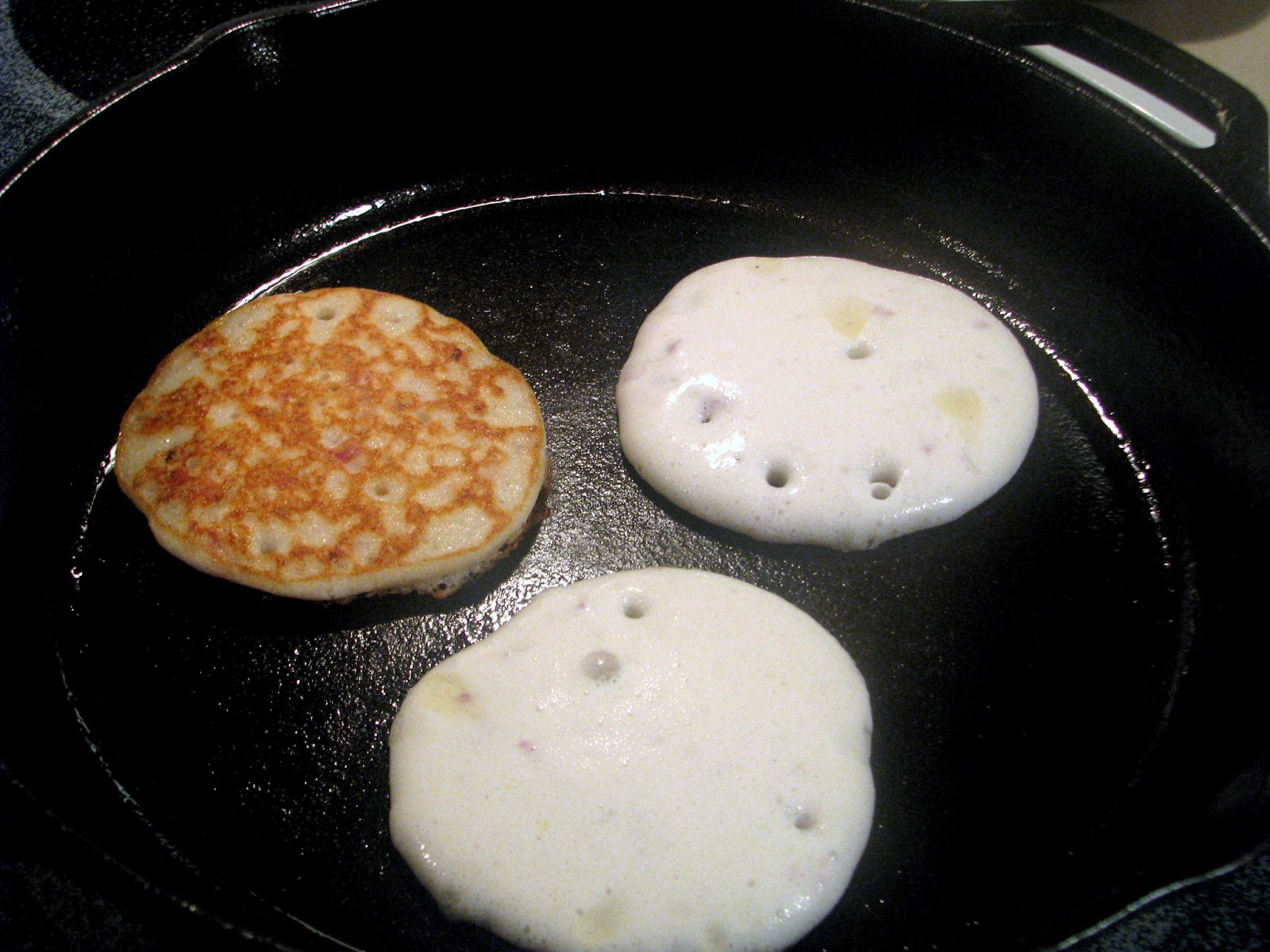
  4. Heat a cast-iron skillet until hot. Pour a ladle of the batter and crisp the pancake with a few drops of oil around the edges of the pancake. Cook on the pancake on medium heat for 2-3 minutes until one side of the pancake is golden and cooked. 
  5. Flip it over and gently press down the pancake to evenly cook the other side.When cooked, transfer to a plate and serve with a side-dish of savory chutney.
 
Let me tell you - these are yummy! Perhaps not as great as the original, because try as I might, I can't recreate their coriander chutney.

I was apprehensive that the pancakes would be tough and rubbery if they were stored for a while, but surprisingly, these pancakes remained soft and tasty even when stored overnight.

This is a wonderful, healthy oothappam that is so easy to prepare, especially on a weeknight.

Saturday, January 19, 2013

Onion Oothappam

Oothapam is a heavier, thicker, softer, Dosai. While dosai could be called a crepe, oothapam could be called a pancake - a savory one. When hot, they are crispy on the outside and soft and fluffy in the inside. The batter for oothapam can be prepared in the same manner as preparing idli batter. Left over fermented idli batter after a day of making idlis can be used to prepare oothapam. Or, this dosai batter that I posted yesterday can be used too. The only slight differences in making oothapam are
  1. The oothapam batter will be slightly thicker to make fat dosais. So don't add too much water while preparing the batter. Or, if you leave behind the vendhaya dosai batter for a day, it will naturally turn slightly thick and will be ideal to make oothapams.
  2. The oothapam batter is not spread into a thin circle while preparation. A ladle (or two ladles) of batter is poured gently on the pan and is left to cook. Pretty much like making pancakes.

 Since my in-laws prepared this oothapam using the vendhaya dosa batter, I'm copy pasting most of the previous post's ingredients and preparation descriptions. I hope no one accuses me of self-plagiarizing ;)

In this variation of oothapam, finely chopped onions are added to the batter. It adds a depth of flavor and crunchiness that's simply great. You can add other vegetables, ginger, or other  spices of your choice.

         Ingredients:
  1. 3 cups parboiled rice
  2. 1/2 cup white raw rice
  3. 3/4 cup whole, de-husked urad dhal / ulundu / black gram dhal
  4. 1 teaspoon fenugreek seeds / vendhayam
  5. a few teaspoons sesame oil
  6. 2 teaspoons salt (or as needed)
  7. 1 medium/small onion, finely chopped.

    mini oothapams with one ladle of batter
     
    Preparation:
  1.  Soak the parboiled rice and raw rice (together) for 4-8 hours. Let the water level come up to 3 inches above the rice
  2. Soak the urad dhal and fenugreek for for 1-2 hours.
  3. Grind the urad dhal in a wet-grinder or a powerful mixie/blender with about 1/2 cup of water until it is fluffy and soft. The consistency of the batter should not be too thick nor too runny. If you lift the batter with a spatula and point it down, the batter shouldn’t run or plop down immediately. It should be a sticky (not greasy, but gooey) lump that stays on the spatula and eventually crawls down.
  4.  If using a wet-grinder, slowly add the soaked (and drained) rice to the ground urad dhal batter and continue grinding until the rice is ground well to a near-smooth consistency. Add about 2 cups of water to grind. Adjust the water depending on the type of rice you are grinding. If using a blender, remove the urad dhal batter and grind the rice in batches. 
  5. Transfer the prepared batter in a bowl, add salt and mix well with your clean hand. When poured, the prepared batter should fall down in ribbons.
  6. Set aside the batter for about 8 hours. It is highly unlikely that it would ferment in a cold, dry place (such as where I live). The batter didn't rise or ferment here. But in India, it might ferment easily. So, store the batter in an appropriate bowl to give room for it to ferment. 
  7. After 8 hours, check the batter. If it has thickened, add some water to dilute it to the consistency of pancake batter. When poured, the batter should fall in easy ribbons. When dropped or ladled on a plate, the batter should spread slightly but not run. When the batter is ready, add the chopped onions/vegetables to it and mix well.
  8. Heat a cast-iron skillet or a non-stick skillet on high heat. When the skillet is piping hot, reduce the heat to medium. Pour a ladle of batter onto the center. Do not spread it out. One ladle results in mini oothapam (which is what my father-in-law made). Two ladles will result in a slightly bigger, fatter oothapam.
  9. Spoon a little bit of sesame oil around the edges of the oothapam.. This step is optional, of course. For the uber diet-conscious person, this may seem unnecessary, especially if using a non-stick skillet. But the sesame oil infuses a delicate flavor and aroma that comes to be associated with the intrinsic taste of dosai. 
  10. Wait for about 2-3 minutes for the oothapam to crisp/cook on one side. Then carefully flip the dosai onto the other side using a flat, broad spatula.You may again spoon some sesame oil around the edges. Wait for about 2 minutes. Flip the oothapam. If you are satisfied that it is cooked (the batter isn’t raw in patches, and the dosai has lots of little bubbles of escaped steam/air), transfer it onto a plate.
 
Serve with any spicy side-dish! These were yummy oothapams, thanks to my father-in-law's meticulous preparation!