Showing posts with label Meenakshi-ammal-project. Show all posts

Tuesday, March 20, 2018

Moong Dal Halwa / Ashoka Halwa

Halwa is a gelatinous-looking Indian sweet that's chewy and rich with ghee (clarified butter). It takes a bit of elbow grease to continuously stir a few simple ingredients until they come together into a blob that is really tasty despite its initial appearance in the pan. Halwa usually takes a lot of ghee to make sure it doesn't stick to the pan while cooking. Consequently, it commonly oozes with ghee and contributes to the overall taste. 

In this version, the moong beans takes significantly lesser amount of ghee and labor. This is a quick and tasty sweet that's sure to please! And it’s also a festive dessert on occasions like Diwali. 

Thursday, September 17, 2015

Poricha Kozhakattai / Fried Wheat Kozhakattai

On the event of Ganesh Chathurthi, everyone back home is abuzz with celebration and preparation of treats. Modhaks/Kozhakattais mark the festive air by lending the sweet aromas of jaggery and cardamom that mingle with the perfumed smells of incense and camphor. There are so many memories of sight and smell and touch. The bursts of colors in red, yellow, green, and lavender from the flowers, the carefully adorned clay idols, the crinkly paper umbrella stuck at the back, the prickly sprigs of wheat grass, the scatter of platters of freshly made kozkattais, vadai and paayasam, the tinkle of prayer bells chiming from the neighbors - are just some of the memories. 

Instead of the traditional kozhakattais made with rice flour, I present another common version prepared with wheat flour. It is much more straightforward, involves lesser time, and turns out really tasty (and yes, it is deep-fried! :)). But invoking the name of Ganesha, set aside that little bit of information :).

My mom often prepares this version, so it also happens to trigger more special memories for me.


Saturday, September 5, 2015

Uppu Cheedai /Savory Seedai

Cheeda/Seedai are festive savory munchies commonly prepared during Gokulashtami (Lord Krishna's birthday) or on Diwali. It is a complement to sweet cheedais prepared with jaggery, rice flour, and cardamom.

The only word of caution while preparing savory cheedais is to exercise extra care while frying them. Cheedais are known to sometimes burst and splutter out of the hot oil because of trapped bubbles of air/moisture. So, drop the balls carefully into the oil and maintain a good distance away during the first minute of frying. Also, make sure to not neglect roasting and sieving the flours, because they are essential steps to make sure the flours are dry and smooth to minimize the risk of spluttering oil.


Friday, September 4, 2015

Rava Paayasam / Semolina Pudding

There are so many different kinds of paayasams (sweetened porridge/pudding). Of all the paayasams that can be made, this version with semolina/rava is one of the simplest and fastest, because rava cooks in no time!


Sunday, January 18, 2015

Coconut Paayasam / Thengai Paayasam

Coconut paayasam (sweet Indian porridge) is a straightforward dessert that's often prepared during special religious occasions. This is very hard to mess up, and takes no time at all to prepare. It therefore becomes the ideal dessert of choice to celebrate festivals that fall on busy weekdays.


Wednesday, October 22, 2014

Gulab Jamun

Gulab Jamun is a rich, melt-in-your-mouth delicacy of fried globules of milk solids that are dunked in a sweet syrup flavored with rose-water, cardamom, and saffron. It is one of my all-time favorite sweet indulgences. 

While there are several easy to prepare gulab jamun mixes that are available in the market, I decided to prepare this from scratch for Deepavali, and I am so glad I did, because it is extremely easy to prepare and is quite fail-proof. Usually, mawa or khova/koya is kneaded along with all-purpose flour to prepare the balls, which are then deep fried and soaked in sugar syrup. I wasn't too keen on spending time preparing khova, so my mom suggested that I use milk powder instead, and the jamuns turned out great - soft, luscious, and delectable in every way. 


Happy Deepavali to everyone!

Tuesday, October 21, 2014

Wheat Thattai

Tomorrow is Deepavali - the Indian festival of lights. As the most celebrated and popular Indian festival, Deepavali symbolizes the entry of light and goodness in everyone's lives. 

Specialized sweets and savories, firecrackers, and shiny new clothes are just some of the many indulgences that the festival brings with it. 

Half away around the world, during a quiet Fall weeknight, people like me celebrate Deepavali by invoking the spirit of warmth and cheer. I usually prepare at least one sweet and savory dish to mark the festival. This time, I thought of trying a slightly different version of thattai - a crunchy snack. Instead of rice flour, I used wheat flour, thanks to the inspiration from Meenakshi ammal's cookbook. 


Friday, September 19, 2014

Tomato and Beetroot Jam

We've been having a healthy harvest of tomatoes from our vegetable patch. It is a real blessing and a highly rewarding exercise. As summer wanes, my ritual is to prepare some fresh fruit/vegetable jam from the summer harvest. This year, the overflowing bag of fresh, plump tomatoes lured me to make some jam with sweet beets.

Although the flavor combination of tomatoes and beets is not obvious, the two come together to make a really delicious combination. The sweet flavor of the beets perfectly complement the tartness of the tomatoes. I have vague memories of this particular jam stewing and cooking away in my grandmother's (and her sister's) kitchen. My scent-memory can smell the beets cooking in the tomato puree, and my taste buds vividly recollect the subtle bite of the juicy beets and the burst of cardamom that seeps through and perfumes the jam. So, suffice to say this is one of my favorite spreads. After several years, I was happy to make a batch of this jam along with my mom.


Thursday, September 18, 2014

Indian Vegetable Sides: Sauteed Cabbage with Coconut

The most simplest way of serving vegetables is to saute them with just a few seasonings; seasonings that truly bring out the flavor of the vegetable and showcase it boldly. 

Along those lines, the recipe I am sharing today is one of the simplest and most elegant forms of preparing Indian vegetable sides. This technique is popularly utilized in South-Indian cooking. There is minimal spice and flavorings, but the presence of coconut gratings and a small amount of green/red chillies and black gram are enough to make the dish tasty. 

This same approach can be used to prepare green beans, carrots, beets, cauliflower etc.


Wednesday, September 10, 2014

Indian Vegetable Sides: Swiss Chard Masiyal

Leafy greens are plenteous in any tropical place, and India is no exception. It teems with a mind-boggling array of herbs and greens, each of which has some medicinal and nutritious value. So, fresh greens are a common vegetable side that features in our meals. In this version, fresh leafy greens are pureed, cooked, and spiced with red chillies, coconut, cumin, and some black gram to make a delicious side that is extremely nutritious.

I have used chard to prepare this masiyal, but you can substitute it with any greens.

Monday, September 8, 2014

Olan

Olan is a simple coconut stew prepared with black-eyed beans and white pumpkin. It is a popular Kerala / Palakkad stew, that's prepared during festivals like Onam.

The simplicity of the dish belies its wonderful and lovely taste! It can be prepared in no time and is nutritious with vegetable/fruits, and protein from the black-eyed beans. And going from recent nutrition "research", coconut is great for you too! I wish some of my grand (and great grand) relatives were alive to hear this, because it's hard not to use coconut in our cuisine, and until recently, we were scorned for the same reason, and our food used to be labeled unhealthy. Of course, moderation (and a sensible head) is the key. No research will validate deep frying pastries in coconut oil... so, moving on ;)


Last month, when I visited one of my aunts, she generously gave us some ripe vegetables/fruits from her lush garden. Amongst those, she gave me an acorn squash and suggested that I make a nice pot of olan with it. Although olan is traditionally made with white pumpkin, any vegetable or squash can be added - we make up rules as we go along :). So I came back home to make a simple and delicious pot of olan with the fresh acorn squash and some carrots.

The lovely acorn squash from my aunt's vegetable patch
Here's how I prepare this simple stew. 

Sunday, August 17, 2014

Vella Cheedai / Seedai

Today is Janmashtami or Gokulashtami - Lord Krishna's birthday. On this festive day, cheedai/seedais, which are deep-fried balls made primarily with rice flour and black gram flour, are prepared. As with most Indian delicacies, there are sweet and savory versions of cheedai. 

I'm sharing a popular sweet version of cheedai today. It is a simple preparation with jaggery syrup sweetening rice flour and black gram flour. Some toasted sesame seeds, coconut and cardamom season the cheedais with crunch and flavor. 

Cheedais have a notorious reputation for bursting when frying in hot oil. It has led to many unfortunate accidents. However, sweet cheedais are less prone to bursting than its savory counterpart. So, if you are attempting this for the first time, be a little cautious and step slightly away from the oil, keeping your face and limbs at a safe distance when the cheedais are frying. But, don't fret much. If an accident-prone clumsy person like me can make this cheedai safely, so can you!


Saturday, August 16, 2014

Murukku / South-Indian Chakli

Murukku is a very popular deep-fried savory snack that's made during festive occasions like weddings, Diwali, and other religious days. Tomorrow is Gokulashtami - Lord Krishna's birthday. So, this is one of the many savory dishes that's made to celebrate the day. 

My husband and I love murukkus, however, these murukkus are made entirely by hand instead of using any equipment to press out the spirals. The prepared dough is slowly spun in a twisted rope-like fashion to make the murukkus, as shown in this video. Now, to do this one needs a special skill and dexterity that I lack! My mom always says this skill is something that you are born with - like the ability to touch your nose with your tongue ;). I have resisted this idea and have tried several times to make these murukkus by hand when I was a teenager, but my success rate has been erratic. I don't want to discourage anyone, though! This is just my limitation. 

So, I have started to make these murukkus using a press. After all, the ingredients are the same, and consequently, the end product tastes the same. If the murukkus are made using a press, they resemble chaklis - another Indian deep-fried equivalent of murukku.

Here's the simple procedure to make murkkus.

Monday, August 11, 2014

Indian Vegetable Sides: Spicy Tindora Stir-Fry

Tindora, also known as Ivy Gourd is commonly had in Indian cuisine. Until I read the wikipedia page, I had no idea that this fruit had so many medicinal properties! There's always something to learn in this wide world. 

In Indian cuisine, tindora is frequently cooked and stir-fried with a spicy curry powder such as sambar powder to make a vegetable side that goes well with rice or rotis. 

This style of cooking and stir-frying vegetables with spices is one of the most basic, simplest, and common ways of preparing Indian vegetable sides. This is almost like a formula. If you know this, you can pretty much prepare any vegetable by currying it!

(Side note: I know tindora is not exactly a vegetable per se, but we are used to regarding it as one because of its prominence in savory dishes. So, please look past the glaring term!)


Sunday, August 10, 2014

Eggplant Masiyal / Brinjal Masiyal

This side dish is called as dosai masiyal, because it is prepared as a side dish for dosais. We don't make this dish often, because dosai is heavenly as it is, and all it needs is a simple sambar, chuntey, or milagai podi to dip into. But, when one has excess eggplants or brinjals in the kitchen and is bored out of their mind to make the same kinds of dishes, this is a nice dish to resort to. 

It is tangy, spicy, and very simple to make - a concentrated mixture of eggplant and tamarind to spice up dosais, idlis, and even rotis!


Friday, August 8, 2014

Indian Vegetable Sides: Plantain Podimas

Podimas is a classic and unique vegetable side prepared by South-Indians. I am sure it is called by different names, but Brahmins call it Podimas, perhaps because the cooked starchy vegetable is shredded and spiced with a simple combination of ginger, green chillies, turmeric, coconut, and lemon juice. 

Podimas can be prepared with potatoes as well (in the case of potatoes, instead of shredding, just gently crumble the cooked potatoes and follow the same procedure), and other starchy vegetables.

Podimas finds its way on plates and festive banana leaves during special occasions, but it's so easy to prepare that it can easily be a regular vegetable side to feature with simple home cooked food.


Wednesday, July 30, 2014

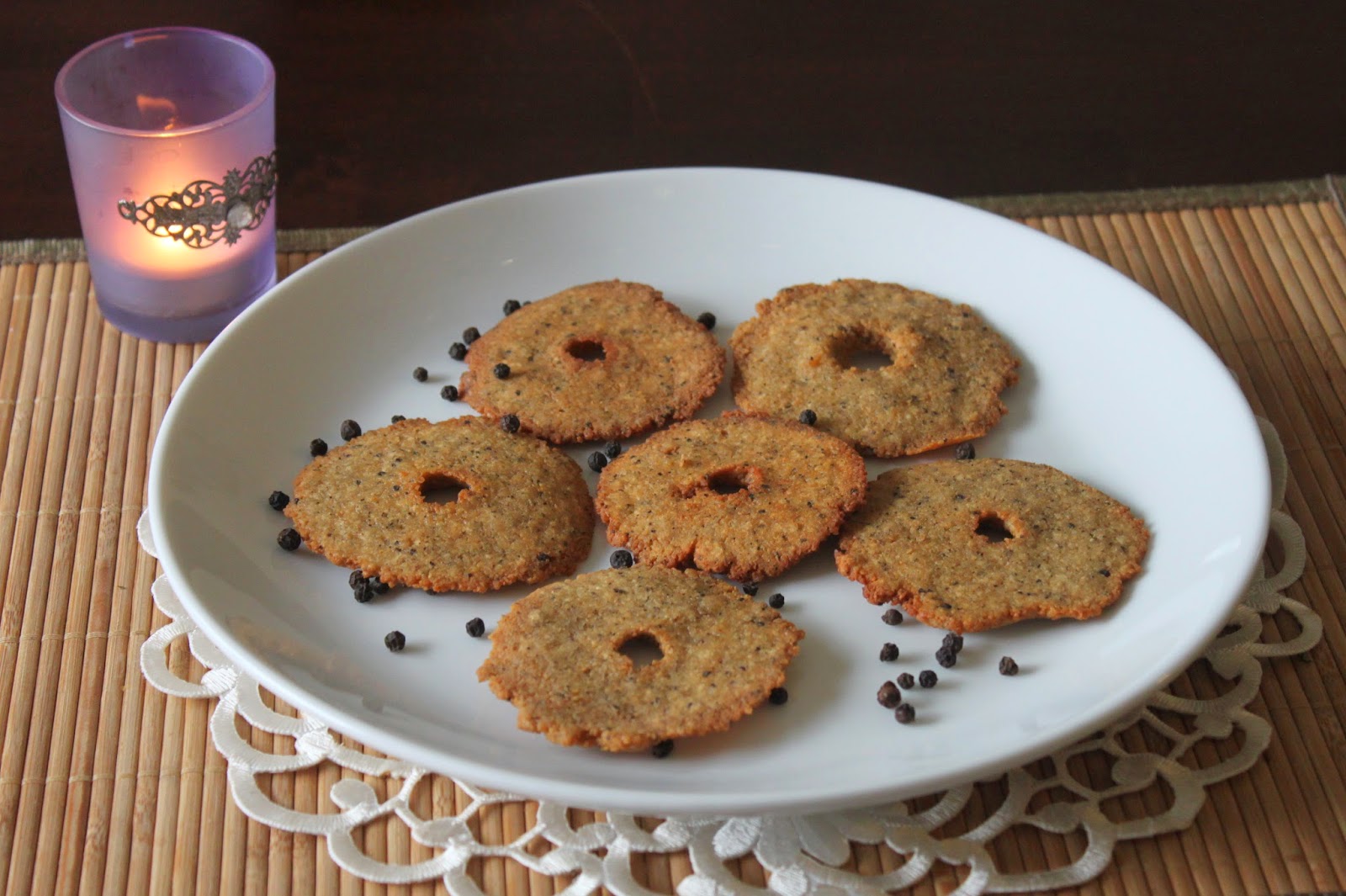
Milagu Vadai / Pepper Vadai (Anjaneyar Vadai)

Milagu vadai is a thin deep-fried disc prepared from coarsely ground whole black gram and lots of cracked black pepper. It is a common religious offering to the Hindu God, Hanuman (also known as Anjaneyar). Ever since I was three years old, I have had a special fascination and reverence towards this particular Hindu God. So, this vadai is a special favorite. I love its simple taste, and the feeling of peace, quite, and hope it evokes.

This is a very simple and easy preparation that takes no time at all to make.


Sunday, July 27, 2014

Indian Vegetable Sides: Brinjal or Eggplant With Freshly Ground Spices

South-Indian cooking heavily uses four ingredients to prepare a common spice blend to season vegetables and lentil-based stews. The four ingredients are: bengal gram, coriander seeds, red chillies, and coconut. These ingredients are dry roasted (or roasted in a little oil) and ground to make a distinctly flavorful blend that elevates the taste of any simple dish.

So, it's no wonder that this blend is used to season and spice vegetables. In this version, brinjals (the small eggplant variety common in South-Asia) are stir-fried with turmeric and seasoned with this aromatic spice blend for a truly delicious vegetable side! This can also be mixed with rice for a really delicious brinjal-flavored rice called vaangi-bath. A small difference is that vaangi-bath is commonly prepared with green-colored eggplants that are first cooked by stewing in tamarind juice. Since it's next to impossible (currently) to find green eggplants in many places outside of India, regular brinjals are good enough substitutes. 

Commonly, really small brinjals are stuffed with this spice blend and then pan-fried for a crunchy and spicy dish called yenna kathirikkai. Since we don't get such small and tender brinjals here, I prepare this version, which is the deconstructed form of the former (plus this version takes way less oil)! My mom often prepares this at home.

This recipe can be used to prepare vegetables such as plantain, elephant yams, and other starchy but hardy vegetables. I know many people are not fond of eggplants/brinjals. But this dish might make them reconsider :)


Friday, July 25, 2014

Indian Vegetable Sides: Beans with Moong Dal

I often get asked how Indians cook their vegetables for sides. Do we add them to the spicy tomato-onion gravy served at restaurants? Do we roast them? Blanch them? Steam them? Saute them? Stir-fry them? What spices and ingredients go into them? etc.

So, I am going to be posting some basic recipes on the different ways we prepare vegetable sides. Since, I am most familiar with South-Indian cuisine, most of my vegetable sides are derived/based on that cuisine. 

Here's a very common and simple vegetable side that we prepare with minimal spices/seasonings. In this version, green beans are cooked with some moong dal (mung beans) for a tasty and healthy vegetable side that truly showcases the inherent flavor of the vegetable without the distraction of strong spices and smells.

You can use the same procedure to cook other vegetables such as cabbage, carrot, beetroot, cauliflower etc. (basically any non-starchy vegetable that doesn't have too much water content in it so that it can withstand its texture while being cooked with the dal).

Thursday, July 24, 2014

Arachu Vitta Sambar / Sambar with freshly ground spices

Arachu vitta sambar, meaning, sambar made with freshly ground spices, is a slightly special and tastier version of regular sambar (which is a tamarind and lentil stew made with vegetable/s or greens). It is commonly made during festive and special occasions, but in our house, I usually make only this kind of sambar, because it so much more flavorful with just a little extra step. Plus, adding freshly ground spices makes the sambar attain its optimum consistency every single time! It's rich, thick, and a very easy crowd pleaser!

In this recipe, I have added pearl onions and radish/daikon to make this sambar. Pearl onions (chinna vengayam) are a popular choice for this kind of sambar. You can add any (diced) vegetable/s of your choice using this basic procedure. Here's how it's done.