Showing posts with label kuzhambu. Show all posts

Thursday, January 16, 2014

Orange Peel Vatha Kuzhambu

Orange Peel is popularly used in many cuisines, and South Indian cuisine is no exception. We make a sweet, tangy and slightly bitter sauce with it (also called as pachidi), and use the dried peel powder in flavorings. My mom recently experimented by making a Kuzhambu (a tangy and spicy gravy) with orange peel and she said the dish tasted really good and unique.

So, upon her successful experiment, I took down her recipe and tried it. True to her word,  it truly is unique tasting, for who has tried orange flavored kuzhambu? It is incredibly flavorful if you are a fan of oranges. Both my husband and I loved the kuzhambu. I must say, there was no hint of bitterness despite me not removing the white pith from the orange peel. I think stewing it in tamarind (and some jaggery/brown sugar) eliminated the bitterness. It was spicy and orangey with a trace of lingering sweetness! Highly recommended.


The recipe is very similar to a standard Vatha Kuzhambu, with just a few tweaks and additions.

Ingredients (serves 4):
  1. About 2 inch ball of tamarind (depending on how tart the tamarind is; 2" is usually sufficient). 
  2. the peel of 1 orange - cut into pieces (comes to 3/4 cup)
  3. 1 tablespoon olive oil / vegetable oil
  4. 1 teaspoon black mustard seeds
  5. 1 teaspoon bengal gram dhal / kadala paruppu / channa dhal
  6. 1/2 teaspoon fenugreek seeds
  7. 1 tablespoon ghee / clarified butter (optional)
  8. 2 teaspoons jaggery / brown sugar
  9. 1 dried red chilli (do not add if you want it mildly spiced)
  10. 2  - 2.5 teaspoons sambar powder
  11. 1 teaspoon turmeric powder
  12. few curry leaves
  13. 1 tablespoon rice flour/rice powder (sometimes besan is used instead of rice flour)
  14. 1/8 teaspoon hing / asafoetida
  15. 1 teaspoon salt (or as needed)
Preparation:
  1. Soak the tamarind in 2 cups of hot water for 20 minutes. Squeeze the juice out of the pulp and drain the tamarind extract. Repeat the process by adding 1 more cup of lukewarm water to the remaining pulp and extract more juice. Repeat a third time if you think the pulp can be juiced more. Discard the pulp.
  2. Heat oil in a medium-size saucepan. When hot, splutter mustard seeds, and then add fenugreek seeds, hing, gram dhal and curry leaves. Fry for a few seconds. 
  3. Add the orange peel and saute on medium heat for 5 minutes.
  4. Add turmeric powder and sambar powder and fry the spices for a couple of minutes.
  5. Add the extracted tamarind juice, an additional 1 cup of water and salt, and let the whole thing boil on medium heat (uncovered) for 35-40 minutes until the mixture reduces in quantity and becomes concentrated. Add more water (if needed) and if you think it tastes too tart. 
  6. Add jaggery/brown sugar (to balance the tartness)
  7. Mix rice flour in 1.5-2 tablespoons water and mix well. Whisk into the kuzhambu to thicken it. Reduce the heat, and simmer the kuzhambu on low heat for 5-10 minutes until it thickens. Add more rice-flour-paste to thicken the kuzhambu more (if needed). 
  8. Remove from heat and mix a dollop of ghee (optional but recommended)
 Enjoy with steaming rice and vegetables on the side!

Saturday, January 5, 2013

Vatha Kuzhambu

In the Tam-Brahm community, Vatha Kuzhambu is the mother of all spicy gravies (kuzhambu). Nutritionally speaking, it has nothing vital, but it is fabulously spicy and flavorful. It is hands down the best Kuzhambu we can offer from our kitchens. 

So what goes in it? Reduced tamarind extract (lots of it) is spiced with sambar powder, chilli powder, dried crisps (vathal, samabar-vadaam), onions, and other dried vegetables/fruits. It can also be made with gourds and other vegetables of your choice.

vatha kuzhambu with sambar vadaam and onions
vatha kuzhambu with manathakkali and okra

Ingredients:
  1. About 2 - 2.5 inches ball of tamarind (depending on how tart the tamarind is; 2" is usually sufficient). 
  2. 1 medium-sized onion, sliced thin
  3. A few dried preserves (if you have any) - sambar vadaams, manathakkali (a kind of fruit that is dried)
  4. 1 tablespoon sesame oil
  5. 1 teaspoon black mustard seeds
  6. 1/2 teaspoon fenugreek seeds
  7. 1.5 teaspoons toor dal / tuvaram paruppu / yellow lentils
  8. 1 tablespoon ghee / clarified butter (optional)
  9. 1 teaspoon jaggery / brown sugar (optional)
  10. 1 dried red chilli
  11. 2  - 2.5 teaspoons sambar powder
  12. 1 teaspoon turmeric powder
  13. few curry leaves
  14. 1 tablespoon rice flour/rice powder (sometimes besan is used instead of rice flour)
  15. 1/8 teaspoon hing / asafoetida
  16. 1 teaspoon salt (or as needed)
Preparation:
  1. Soak the tamarind in 2 cups of hot water for 20 minutes. Squeeze the juice out of the pulp and drain the tamarind extract. Repeat the process by adding 1 more cup of lukewarm water to the remaining pulp and extract more juice. Repeat a third time with 1/2 cup warm water if you think the pulp can be juiced more. Discard the pulp.
  2. Heat oil in a medium-size saucepan. When hot, splutter mustard seeds. Add fenugreek seeds, hing, curry leaves, red chilli, and toor dal and fry until fenugreek and dal begins to change color. 
  3. Then, add onions/vegetables and the dried preserves (if adding) and saute on medium heat until the onion begins to turn translucent (about 5 minutes).
  4. Add turmeric powder and sambar powder and mix in the spices for a couple of minutes.
  5. Add the extracted tamarind juice, an additional 1-2 cups of water, jaggery/brown sugar (to balance the tartness) and salt, and let the whole thing boil on medium heat (uncovered) for 35-40 minutes until the mixture reduces in quantity and becomes concentrated. Add more water (if needed and as needed if there isn't enough liquid) and if you think it tastes too tart.
  6. Mix the rice flour in 1.5-2 tablespoons water and mix well. Whisk into the kuzhambu to thicken it. Reduce the heat, and simmer the kuzhambu on low heat for 5-10 minutes until it thickens. Add more rice-flour-paste to thicken the kuzhambu more (if needed). 
  7. Finally, mix in some ghee/clarified butter.
Remove from heat and serve hot with rice! Vatha kuzhambu and curd rice is to die for!

Friday, December 28, 2012

Paruppu Urundai Mor Kuzhambu

As authentic as authentic can be, this is by far one of the most traditional Tamil Brahmin dishes there can be. Mor Kuzhambu (recipe from an earlier post of mine) is a gravy made from buttermilk or sour yogurt. Sometimes, steamed lentil dumplings (paruppu urundai) are added to the gravy to give it some additional texture and taste. The dumplings can be mixed with rice and had in combination with the spiced yogurt gravy. These are like little South Indian koftas to include more protein in our vegetarian diets. 

My in-laws are visiting, so this space will see a splurge of more authentic Tam-Brahm dishes!

To prepare the paruppu urundais (as per my mother-in-law's recipe):

Ingredients (for 8 urundais)
  1. 1/2 cup thoor dhal / thuvaram paruppu
  2. 3 dried red chillies
  3. 1/4 teaspoon hing
  4. 1/2 teaspoon salt or more
Preparation
  1. Wash the thoor dhal and soak it in water for 2 - 2.5 hours. 
  2. Rinse the dhal well and grind it with red chillies, hing, and salt, with just a couple of sprinklings of water (about 1 -2 tablespoons of water or slightly more if absolutely necessary). 
  3. Coarsely grind the dhal (as much as possible) so that you can form small chunks of balls/ irregular shaped dumplings with your hand. 
  4. Steam the lentil dumplings for about 15 minutes on high heat in greased idli plates (greased with sesame oil) or a vegetable steamer until a tooth pick inserted in the center comes out clean and dry.
  5. Slightly cool the dumplings before adding to the gravy
The steamed lentil dumplings - paruppu urundais

To prepare the mor kuzhambu with the dumplings (copy pasting most of the recipe from my previous post)

Ingredients:
  1. 3/4  teaspoon coriander seeds
  2. 1 teaspoon raw rice
  3. 1 teaspoon cumin seeds / jeera
  4. 3 cups buttermilk or diluted yogurt that’s slightly sour
  5. 2 tablespoons shredded/grated coconut
  6. 1x1 inch piece of ginger roughly chopped
  7. 2-3 green chillies or dried red chillies (depends on how spicy they are and how spicy you’d like)
  8. 1 teaspoon turmeric
  9. 2 teaspoons vegetable / olive oil
  10. 1 teaspoon black mustard seeds
  11. ¼ teaspoon hing / asafoetida
  12. a few curry leaves
  13. ¾ teaspoon salt
  14. the prepared paruppu urundais / dumplings
Preparation:
  1. Soak the rice, cumin seeds and coriander seeds in ¼ cup of water for 10 minutes.
  2. Grind together the yogurt / buttermilk along with the coconut, the soaked coriander + rice + cumin seeds, ginger and green chillies. This forms the base of the gravy.
  3. Transfer the ground mixture to a medium-sized saucepan, and add turmeric, and salt. Heat this on medium-heat for 5 minutes until the gravy heats through. 
  4. Add the dumplings now. Heat on low-medium heat for 10 minutes or so until the gravy comes to one boil. If the gravy is too thick, add a little bit of water to thin it down and heat for an additional 5 minutes or so. Remove from heat. Do not over-boil the buttermilk or yogurt - it will curdle.
  5. In a teaspoon of oil, splutter mustard seeds, add hing and a few curry leaves. Add this garnish to the Mor Kuzhambu. 


The more the paruppu urundais/dumplings soak in the mor kuzhambu the better it will taste. So the whole dish tastes better when it is well rested.

Friday, December 21, 2012

Poricha Kuzhambu/ Poricha Kootu

This is a popular South-Indian side-dish that is considered as a healthier substitute for Sambar (I know, I am yet to write about the popular Sambar). Sans tamarind and with a generous amount of lentils and vegetables, it is healthy and sumptuous when had with rice or roti.


Ingredients:
  1. 1/2 Cup Thoor Dhal / Thuvaram paruppu
  2. 1.5 - 2 cups worth diced white pumpkin / or any kind of gourd / vegetables
  3. 3.5 teaspoons split urad dhal /ulutham paruppu 
  4. 2 teaspoons coriander seeds / dhania (my mother-in-law adds this)
  5. 1/4 cup grated coconut
  6. 1 teaspoon black pepper corns
  7. 1 teaspoon cumin seeds / jeera
  8. 2 dry red chillies
  9. 1 teaspoon turmeric powder
  10. 2 teaspoons sambar powder
  11. 1 teaspoon black mustard seeds
  12. a few curry leaves
  13. 2 tablespoons vegetable / olive oil
  14. 1 teaspoon salt (or as needed)
  15. 1/4 teaspoon hing / asafoetida
Preparation (steps 1, 2, and 4 can be done in parallel to save time and avoid over cooking the kuzhambu)
  1. Cook the toor dhal / lentils with enough water to cover it. Cooking the dhal in a pressure cooker results in the best texture for this kuzhambu, but if you don't own a pressure cooker (or are apprehensive of cooking in one (like me)), cook the lentils for about 40 minutes or more (adding more water when needed) until it can be mashed. 
  2. Cook the pumpkin/vegetable with about 1 cup of water along with turmeric powder and sambar powder on medium heat (about 10 minutes). Remove from heat when the pumpkin is almost done but not completely done. 
  3. Add the cooked pumpkin/vegetable (along with the turmeric powder - sambar powder broth in which it was stewed) to the cooked lentils. Add a little more water if needed and bring the whole thing to a boil on low-medium heat. Add salt as needed at this point. When it comes to a boil, reduce the heat to low and simmer until the spice-paste (below) is added. Do not over boil/cook at this stage. Just make sure there is no raw smell of lentils.
  4. In a tablespoon of oil, roast the pepper corns, jeera, red chillies, dhania, and split urad dhal until the dhal begins to turn golden and pepper corns splutter. At this point, switch off the heat and add coconut and hing and stir/roast in the residual heat.
  5. When cooled, grind the above roasted spices with 1/4 cup of water (or as needed) to grind into a smooth paste. 
  6. Add the spice paste to the simmering lentils and pumpkin. Stir well and keep simmering for another 5 minutes. 
  7. In the remaining tablespoon of oil, splutter mustard seeds and curry leaves. Add the garnish to the kuzhambu and remove from heat. 
Serve with steaming rice with a dollop of ghee!

Sunday, February 5, 2012

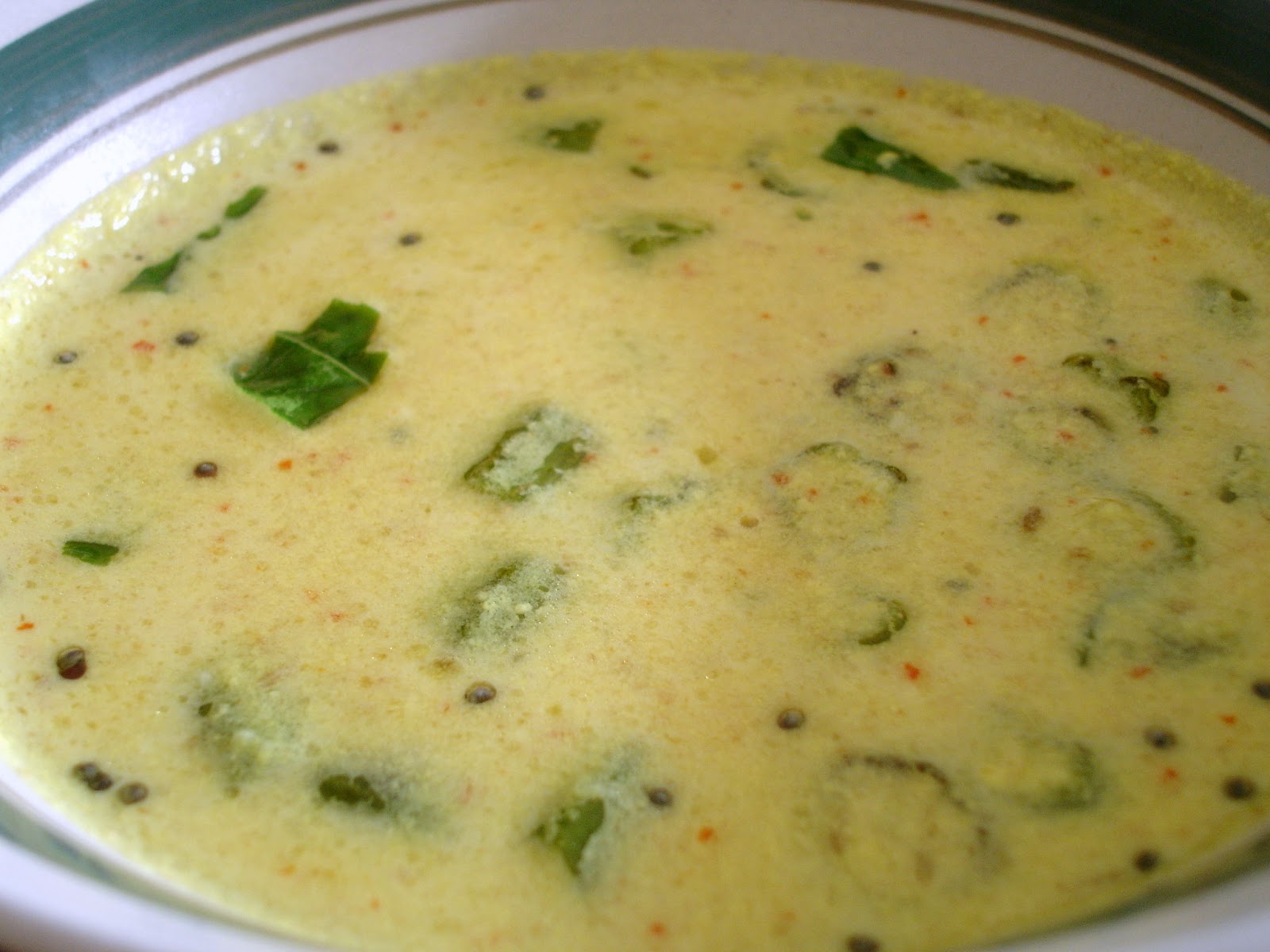
Mor Kuzhambu

Mor Kuzhambu is another yogurt-based gravy spiced with chillies, ginger, cumin, and coconut. It is usually made with day-old yogurt that is slightly sour and diluted with water to create buttermilk. This forms the prime ingredient. 

 
Ingredients:
  1. ¼ cup diced okra / ladies finger / squash
  2. 3/4  teaspoon coriander seeds
  3. 1 teaspoon raw rice
  4. 1 teaspoon cumin seeds / jeera
  5. 3 cups buttermilk or diluted yogurt that’s slightly sour
  6. 2 tablespoons shredded/grated coconut
  7. 1x1 inch piece of ginger roughly chopped
  8. 2-3 green chillies or dried red chillies (depends on how spicy they are and how spicy you’d like)
  9. 1 teaspoon turmeric
  10. 2 teaspoons vegetable / olive oil
  11. 1 teaspoon black mustard seeds
  12. ¼ teaspoon hing / asafoetida
  13. a few curry leaves
  14. ¾ teaspoon salt
Preparation:
  1. Soak the rice, cumin seeds and coriander seeds in ¼ cup of water for 10 minutes.
  2. In a teaspoon of oil, fry the diced okra / squash until it cooks. Remove and set aside.
  3. Grind together the yogurt / buttermilk along with the coconut, the soaked coriander + rice + cumin seeds, ginger and green chillies. This forms the base of the gravy.
  4. Transfer the ground mixture to a medium-sized saucepan, and add turmeric, salt, and the fried/cooked vegetable. Heat this on medium-heat for 10 minutes or so until the gravy comes to one boil. If the gravy is too thick, add a little bit of water to thin it down and heat for an additional 5 minutes or so. Remove from heat. Do not over-boil the buttermilk or yogurt - it will curdle.
  5. In a teaspoon of oil, splutter mustard seeds, add hing and a few curry leaves. Add this garnish to the Mor Kuzhambu.

It’s a very simple dish that goes well with steamed rice. Since the coconut in the buttermilk / yogurt doesn’t store well, the shelf-life of this dish is quite short.

Tuesday, July 19, 2011

Pepper Kuzhambu

Milagu (black pepper corns) is universally used in all cuisines to add heat to the dishes. Some Americans have been pleasantly surprised to know that black pepper takes an important place in the exotic range of Indian spices. To many westerners, Indian cuisine is synonymous to spiciness, especially the spicy bite of chillies. They never imagine their familiar and rustic pepper-corns playing a vital role in many of our key dishes.

Contrary to the burning heat of chillies, the sharp sting of black pepper is supposed to heal internal wounds. So, it is customary for black pepper to be used in abundance in comfort foods, home-remedies and foods for sore-throat, fever and other ailments.

Milagu Kuzhambu is basically a thick gravy of tamarind pulp, boiled and reduced in freshly ground black-pepper and a few red chillies. Due to the heavy reduction of tamarind, this Kuzhambu stores well in the fridge - and like good wine, the flavors are supposed to seep in and get better over time. This is yet another popular Tamizh side-dish, but I was quite surprised to not find its recipe in Meenakshi ammal’s book. Maybe the book hasn’t been indexed properly or the dish is called by another name that I don’t recognize.

So, here is my mother’s recipe.

Ingredients:
  1. 3-4 teaspoons of black peppercorns (I use 3)
  2. 1.5 dried red chillies (or more depending on your level of tolerance to heat)
  3. 1 teaspoon of toor dal (lentils) / tuvaram paruppu
  4. 1 teaspoon of turmeric (turmeric is another antiseptic; good at healing wounds)
  5. 2 inch ball of tamarind (or more, if the tamarind isn't tart enough)
  6. A small piece of jaggery
  7. Salt to taste
  8. 3 Tablespoons of sesame oil
  9. 1 teaspoon of mustard seeds
  10. ¼ teaspoon of hing
  11. A few curry leaves (up to 2 strips/sprigs)


Preparation:

  1. Heat 1-2 tablespoons of sesame oil in a pan (medium heat)
  2. When hot, add the pepper corns and roast for 2 minutes
  3. Add thoor dhal and dried red-chillies and continue to roast till the pepper begins to pop. Immediately remove from heat (my mother warns me that the pepper should not be over-roasted)
  4. Add the curry leaves to the pan. The leaves release their flavor in the residual heat. Let the ingredients cool.
  5. Grind the mixture with a sprinkling of water into a relatively smooth paste (the paste is likely to be a bit coarse)
  6. Soak the balls of tamarind in 1.5 cups hot water for about 15 minutes, and extract the rich juice from the tamarind pulp (one basically uses their hands/fingers to squeeze out the juice). Keep adding water to the tamarind until you extract most of the juice.
  7. In a saucepan, add the tamarind juice, 2 cups of water, a piece of jaggery, turmeric, salt, and the ground pepper-chill mixture, and heat it over medium-low heat for 15 minutes. Switch over to low heat after the initial raw smell of tamarind dissipates.
  8. Heat the kuzhambu for about 40-45 minutes. The resulting kuzhambu should be of the consistency of rich gravy (the kuzhambu continues to thicken as it stays in the fridge)
  9. To garnish, splutter some mustard seeds in heated sesame oil. Add a bit of hing and a few curry leaves to the spluttering mustard seeds. Toss it into the kuzhambu to add a burst of fresh aroma of sesame oil, hing and curry leaves.
Pepper kuzhambu is supposed to be spicy, as the tartness of the tamarind demands some spice. Else, the kuzhambu will be bland with just the one-note flavor of tamarind. But if you are apprehensive, you can halve this recipe and add just two teaspoons of pepper. You can also add more jaggery to balance the spice level, as well as to reduce the tartness of the tamarind.

This kuzhambu is ideal with cooked rice (a dollop of ghee on the cooked rice will not hurt at all). It is also a wonderful side-dish for idlis, dosais, and rotis.